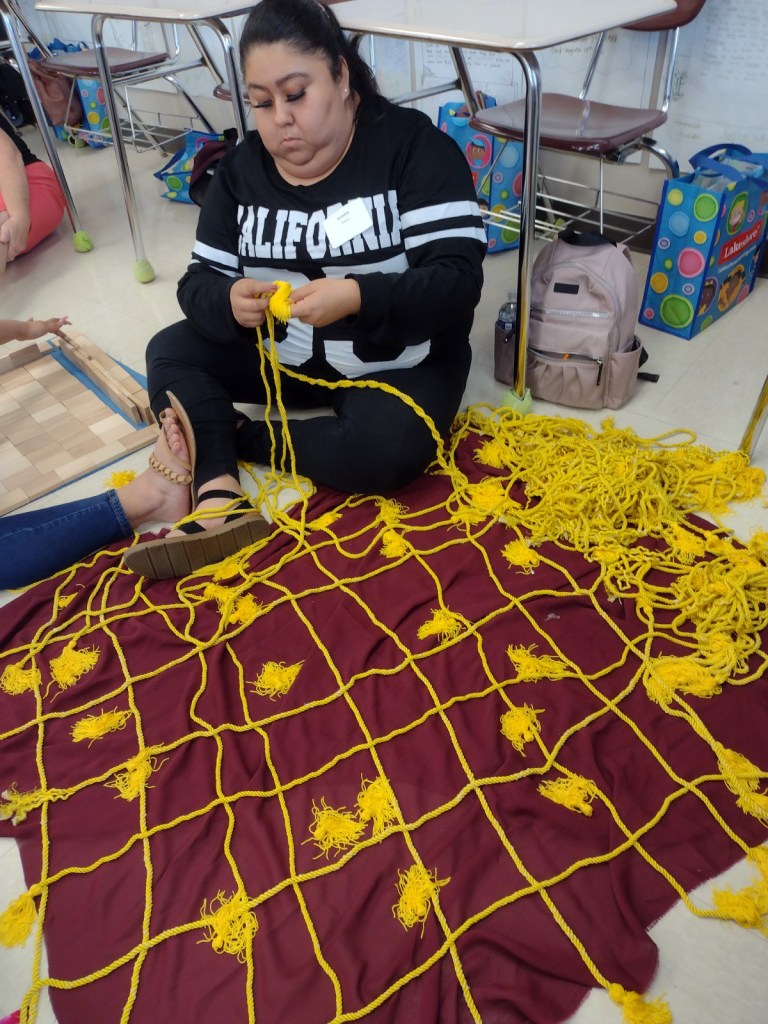
On February 25, 2023, Jasmine participated in a PLAY Workshop at the Manatee Conference on Young Children. Following 15 minutes of silent, solitary self active play, Jasmine came up to me and told me with heartfelt emotion, “This was a nice experiment where I was able to create something out of tassels. A pattern came into my head. When I finish it looked like a fishing net. It brought me a memory of when I went fishing with my family.”
I was touched by Jasmin’s expressed sentiment and the emotional connection she made between her play and her earlier experience of fishing with her family. I see this as an illustration of Self Active Play Principle #2: Hands-on play and art making with open-ended materials reconnect the individual with earlier stages of human development, spontaneously balancing and strengthening hope, will, purpose. competence, fidelity, love, care, and wisdom.
The journal comments of each player reflects the essential personal meaning and value of their experience to them.
Keep in mind what Tom Henricks says about play with objects. “Our play is not merely interaction with external objects, it is interaction with our own sometimes deeply cherished visions. In brief, our play with objects is inevitably self-play.” (Henricks, T., 2015, Play and the Human Condition, p82)

Heather writes: “I chose the picture frame pieces. While I worked, I started putting the different pieces together to form shapes. As I listened to the music. I just really focused on where the pieces fit and I ended up making a large golden star. And I then created several small structures that were underneath the star. They started out as an Asian home or temple, then it transformed into the Nativity scene. Finally, it became a garden with a home and a gazebo. I feel very relaxed after the play session is over.”

“The moment I saw the driftwood I knew it would be my first choice. I envisioned some type of structure before I knew the exact pieces I would have to use. Getting the abstract pieces to fit the way I wanted initially was harder than I anticipated, but I enjoyed the trial and error that led me to bringing my vision to life. I also loved getting to know each piece as they were so unique. Their weight was distributed differently and each laid comfortably in its own way. The entire experience was relaxing and peaceful.”
The silent, solitary play is a mindfulness practice, a meditation involving creative contemplation. Teachers view it as a form of Self-care.
Abigail shared: “As a preschool school, teacher and mother of young children, six and seven, it was very nice to enjoy quiet time to create something of my own for no other reason than relaxation and pleasure. I also struggle with anxiety and the prompt of being silent, and having been given tools to play with, without any sort of direction was very freeing, it allowed me to relax and clear my head in an otherwise very busy life. Thank you!“
 Drew Thoughts